THE CYCLE / STAGE 04
Infiltrate.
What the site doesn't need soaks back into the ground — buffering storm peaks instead of overloading the sewer.
Give it back to the earth.
A paved industrial site turns rainfall into a surge. Every square metre of roof, yard and access road that used to absorb water now sheds it in minutes, and the sewer takes the whole peak at once. That is how sites flood, and how networks get overloaded downstream.
The answer is not a bigger pipe. It is somewhere for the water to wait — and, where the ground allows, somewhere for it to go.
The crate field
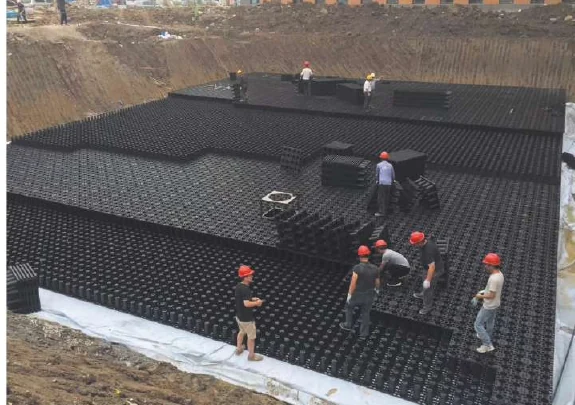
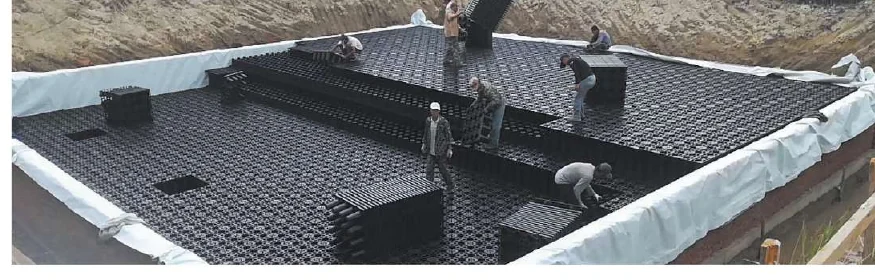
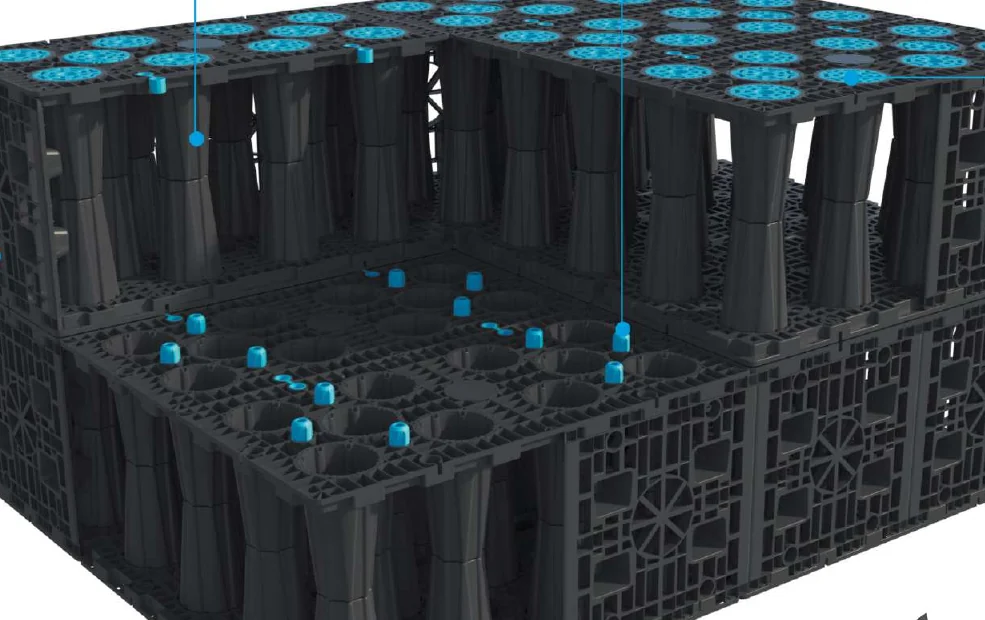
Modular blocks laid like brickwork across the excavation, forming a single structure that is up to 95% void. That void is the storage. Wrapped in geotextile alone, water percolates out through the base and sides into the surrounding soil; the field fills during the storm and empties slowly afterwards, ready for the next one.
Two builds, one product
- Infiltration. Geotextile wrap only. Water returns to the ground and recharges it. Used where soil permeability and groundwater level allow.
- Attenuation / storage. Geotextile plus geomembrane, making the field watertight. Water is held and released at a controlled rate, or kept for reuse. Used where infiltration is not permitted or the ground will not take it.
It goes under the yard
The blocks carry vertical load, so the field can sit beneath a car park, hardstanding or access road. The surface stays fully in use — which on a constrained industrial site is usually the only place the volume can go.
Inspectable and cleanable
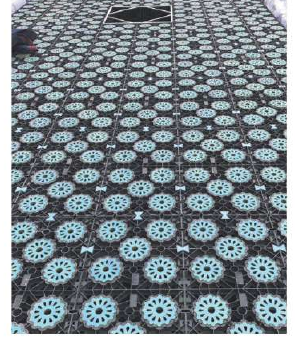
Inspection necks at the inlet and outlet allow the interior to be surveyed by camera and flushed hydrodynamically, so the field can be maintained rather than simply buried and forgotten.
Why it is cheap at scale
Volume per truck is the reason. The elements for a 300 m³ reservoir travel in a single euro-truck where comparable systems need up to four — and they are assembled at roughly a cubic metre a minute, by hand.